Amazon Bedrock AgentCore Gateway Explained: The 'API Gateway' for AI Agents
If you’ve ever built a real-world autonomous AI agent or connected Large Language Models (LLMs) to corporate infrastructure, you know the biggest hurdle isn’t prompt engineering—it’s giving the agent access to real enterprise tools and APIs without creating a security and maintenance nightmare.
With the rapid adoption of the Model Context Protocol (MCP), connecting LLMs to databases, SaaS APIs, and Lambda functions has become the industry standard. But in an enterprise with hundreds of REST endpoints, dozens of microservices, and strict IAM security policies, who builds, hosts, and monitors all those individual MCP servers?
AWS recently addressed this with the announcement of Amazon Bedrock AgentCore Gateway, a fully managed service built to act as the centralized "API Gateway for AI Agents".
(Official announcement reference: AWS Machine Learning Blog - Introducing Amazon Bedrock AgentCore Gateway)
Here is a simple, no-fluff breakdown of what it is, why it matters, and how it transforms agent tool architectures.
1. What is AgentCore Gateway? (The 30-Second Elevator Pitch)
Think of AgentCore Gateway the same way you think of Amazon API Gateway, but built specifically for autonomous AI agents and the Model Context Protocol (MCP):
- Standard API Gateway: Takes HTTP requests from web/mobile clients ➔ routes them to Lambda / microservices with Auth & Rate Limiting.
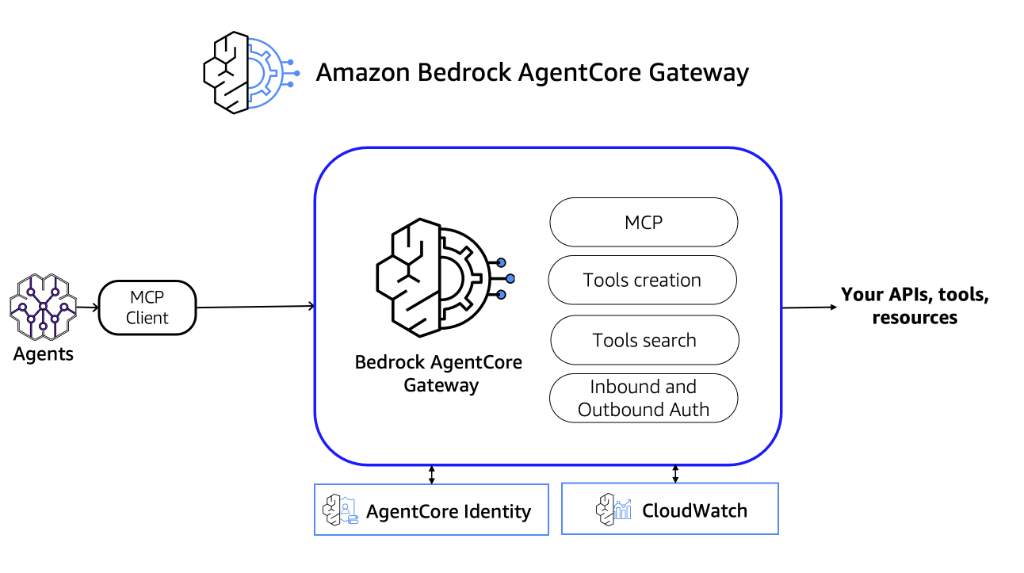
- AgentCore Gateway: Takes MCP tool calls from AI agents ➔ translates them on-the-fly into REST APIs, Lambda functions, or Smithy models with enterprise authentication and semantic tool discovery.
You no longer need to write, containerize, or host custom MCP server wrapper code for every single internal API.
2. The 3 Big Enterprise Problems It Solves
🛑 Problem 1: "Tool Overload" & Context Window Bloat
When an enterprise has 300+ tools, dumping all 300 JSON schemas into an agent's prompt causes two major failures:
- Massive token costs billed on every single turn of the conversation.
- Model hallucinations & paralysis, causing the agent to pick the wrong tool or fail completely.
The Gateway Fix: Semantic Tool Discovery (x_amz_bedrock_agentcore_search)
Instead of pre-loading 300 tools upfront, Gateway gives the agent a single built-in semantic search tool. When the user asks: "Check the inventory levels in our Chicago fulfillment warehouse", the agent asks Gateway for inventory tools, and Gateway dynamically returns only the relevant check_inventory schema on demand.
🛑 Problem 2: Zero-Code MCP Tool Creation
Turning existing REST APIs into MCP tools previously required writing custom Python or TypeScript server glue code, packaging it into Docker containers, and managing hosting.
The Gateway Fix: You simply point Gateway at an OpenAPI specification, a Smithy model, or an AWS Lambda ARN. Gateway automatically converts them into compliant MCP tools over streamable HTTP transport with zero manual code.
🛑 Problem 3: Dual-Sided Enterprise Security
How do you let an AI agent invoke backend databases without exposing raw database credentials, admin tokens, or opening perimeter firewalls?
The Gateway Fix: Dual-Sided Isolation
- Inbound Auth (Agent ➔ Gateway): Uses OAuth 2.0 (via Amazon Cognito, Okta, Auth0, or 2LO/3LO token flows) to verify exactly which agent, application, or user is making the tool request.
- Outbound Auth (Gateway ➔ Backends): Gateway assumes scoped AWS IAM Roles for Lambda/Smithy or securely injects API Keys and OAuth tokens into downstream REST endpoints via AgentCore Identity. The AI agent never sees or touches backend credentials.
3. High-Level Architectural Flow
[ AI Agent / Claude / Bedrock Agent ]
                   │ (Inbound MCP via OAuth 2.0 / Cognito / Okta)
                   ▼
┌────────────────────────────────────────────────────────┐
│          Amazon Bedrock AgentCore Gateway              │
│  ┌──────────────────────────────────────────────────┐  │
│  │ • Semantic Tool Search (x_amz_search)            │  │
│  │ • Protocol Translation (MCP ➔ REST / Lambda)     │  │
│  │ • IAM Role Assumption & Credential Injection     │  │
│  │ • CloudWatch Metrics & CloudTrail Audit Logs     │  │
│  └──────────────────────────────────────────────────┘  │
└──────────────────────────┬─────────────────────────────┘
                           │ (Outbound Scoped Invocations)
        ┌──────────────────┼──────────────────┐
        ▼                  ▼                  ▼
  [ AWS Lambda ]    [ OpenAPI REST ]    [ Smithy APIs ]
4. Why This Matters for Solutions Architects
Amazon Bedrock AgentCore Gateway bridges the gap between hacky agent prototypes and governed enterprise platforms:
- Centralized Governance: Full observability through Amazon CloudWatch metrics (invocations, latency, error throttles) and AWS CloudTrail audit logs for end-to-end security compliance.
- Zero Infrastructure Burden: As a fully managed serverless service, there are no EC2 instances, containers, or Kubernetes clusters to manage.
- Future-Proof Interoperability: As MCP and Agent2Agent (A2A) specifications evolve, AWS handles the protocol updates under the hood while your underlying microservices remain unchanged.
Enterprise agent tooling is rapidly shifting from manual script glue to managed gateway infrastructure.
For the complete technical deep dive and setup instructions, check out the official AWS Announcement and AWS AgentCore Developer Guide.
Discussion
Loading…