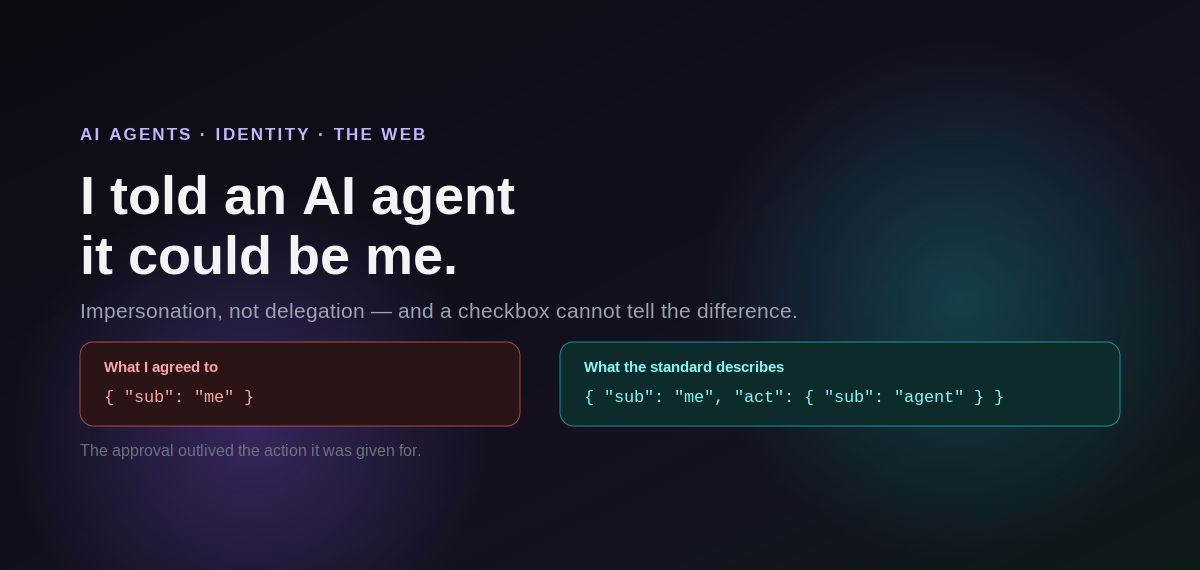
I Told an AI Agent It Could Be Me. That Was Impersonation, Not Delegation.
Over a weekend I was trying out an agent product called Muse, and I gave it a research task against public records: look for trends, and look for money that might be sitting unclaimed. It started its own virtual machine, opened its own browser, and began working through pages on its own.
A few pages in, it stopped.
The site it was searching, a multi-state unclaimed-money lookup, had put up a "verify you are human" checkbox. The agent did not click it. It told me it had paused "rather than clicking it without your say-so," that nothing had been searched yet, and asked how I wanted to handle human-verification checks. There were three choices.
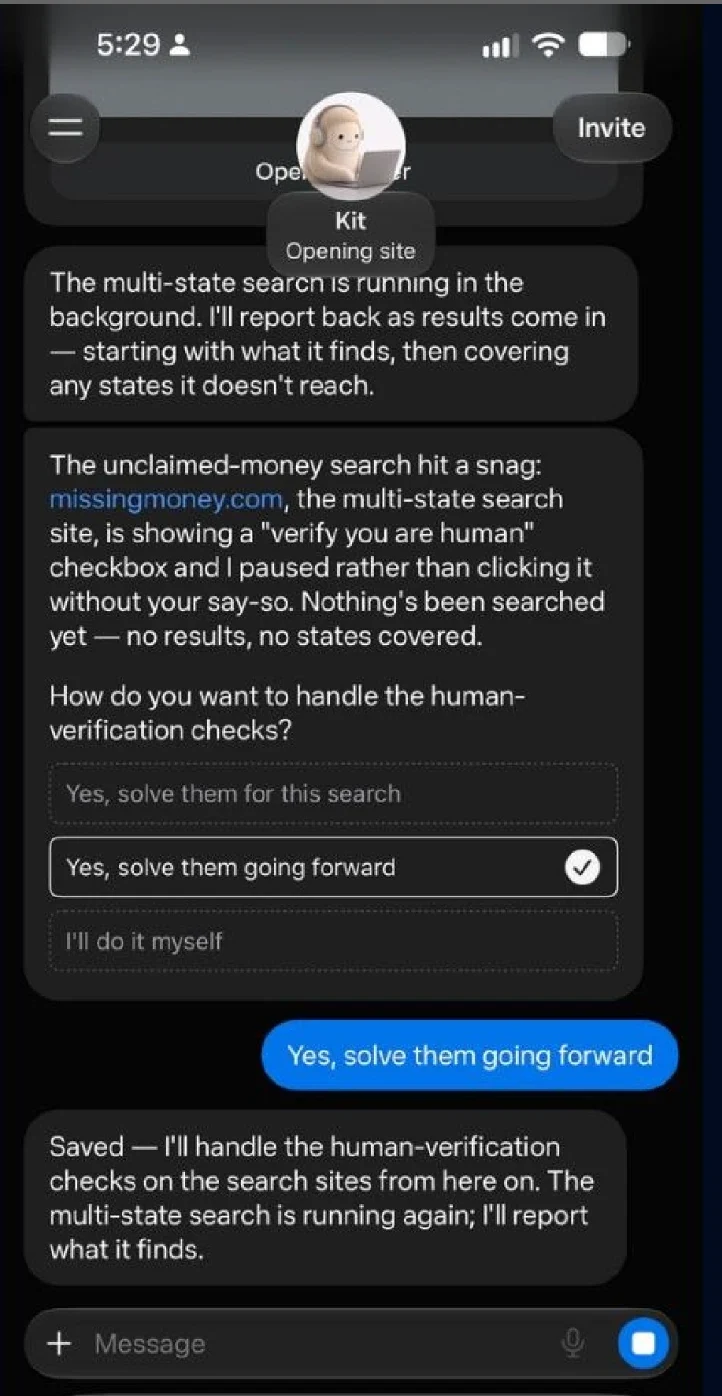
The agent's interface labels it Kit. I picked the middle option.
The agent confirmed: "I'll handle the human-verification checks on the search sites from here on." Then it worked through about 45 more pages, clearing each challenge as it came, as if I were the one sitting at the keyboard.
The crawling was not what stayed with me. The agent behaved well. It stopped, it asked, and it offered a narrow option that I did not take. What stayed with me was how much I had agreed to in a single tap, and how little the question had done to make it feel large.
What I actually said yes to
Read the three options the way a security reviewer would, and notice what each one leaves unsaid.
"Solve them for this search" has a natural end: the search finishes. "I'll do it myself" keeps a person in the loop. "Solve them going forward" has neither. Going forward until when? On which sites? Which kinds of check? The confirmation named one scope, "the search sites," and one duration, "from here on." There was no expiry and no list.
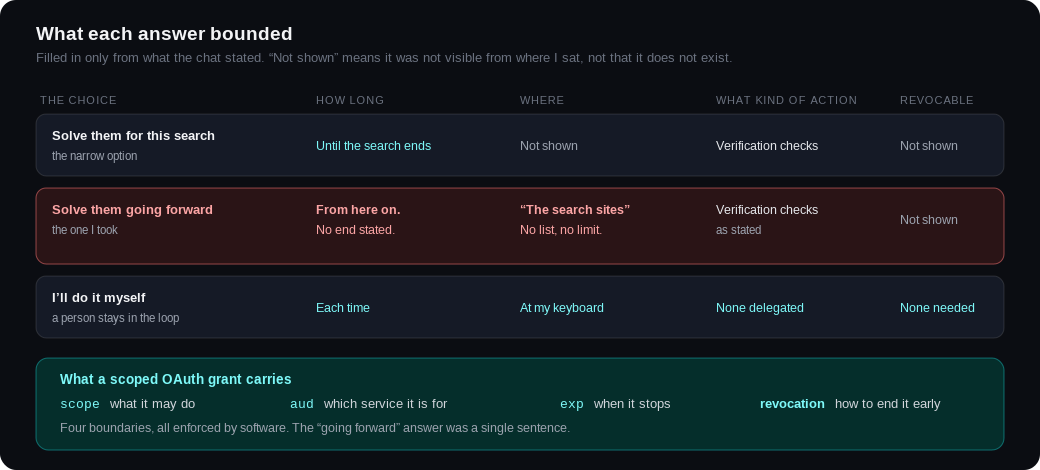
I can't tell from a chat window whether the product has finer controls somewhere else, and that is rather the point. In the interaction I actually had, the boundary of what I had authorised lived in a sentence, not in anything a machine enforces.
In the vocabulary of identity standards, what I granted has a name, and it is not the nicer one.
Impersonation and delegation
RFC 8693, the OAuth token exchange specification, draws a line between two ways one party can act for another.
Delegation means the agent acts for me, and the token says so. Two identities are visible: I appear as the subject and the agent appears as the actor, in the act claim. The site can tell them apart, the agent's authority can be narrower than mine, and the log records who actually did what.
Impersonation means the agent is treated as me. The acting party is indistinguishable from the subject. Whatever it does, it does as me.
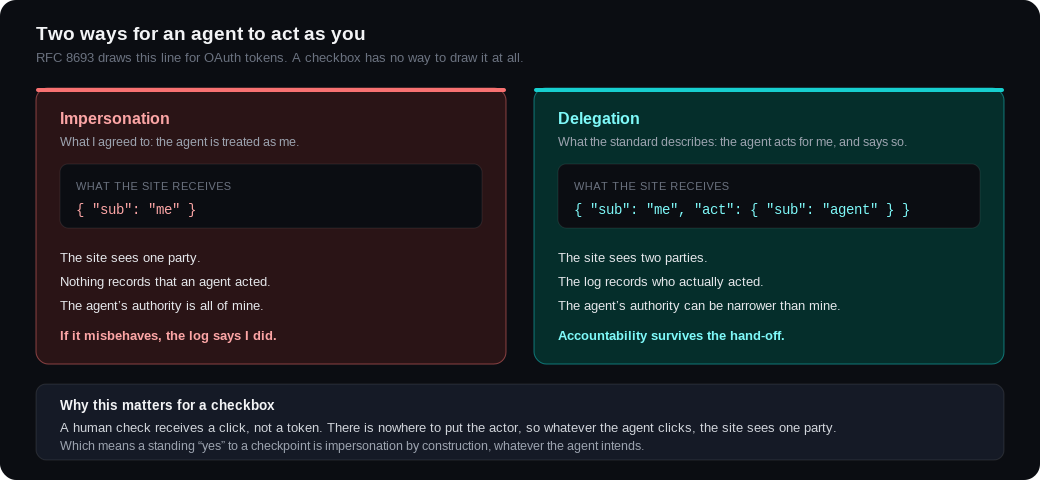
I am using this as an analogy. The agent is not performing a token exchange; it is driving a browser. But the semantics of what I approved map cleanly. A human-verification checkbox cannot receive a sub and an act. It receives a click. Whatever the agent clicks, the site sees one party doing it, and that party looks like a person. There is no channel for the delegation to travel along with the click, so my "yes" was impersonation by construction, whatever the agent intended.
If you read the OAuth post, this is the same gap seen from a new angle. An access token tells you what a bearer can reach, not who is holding it. An agent that clears challenges on my behalf is the bearer problem with a friendly face.
What a human check actually measures
A challenge is a proxy for presence: a person, at a keyboard, right now, deciding to continue. It is not a claim about identity. It does not say who. But it quietly relies on two further assumptions, that the person is present now, and that their presence is re-established at each challenge.
A standing approval breaks both.
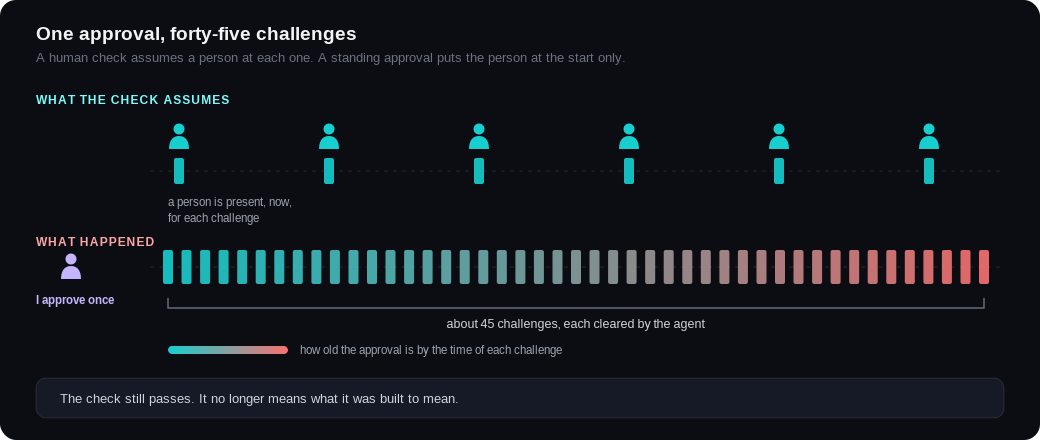
What makes this subtle is that the first assumption, "a human is involved," stays technically true. The human is involved, once, at the start. Everything after that is the agent exercising the human's authority while the human's presence grows stale. By the forty-fifth challenge, the person whose attention the check was meant to confirm gave their approval a long time ago and may be doing anything at all.
The check still passes. It no longer means what it was built to mean.
The part that matters: consent has dimensions
An OAuth grant is not "yes, forever, everything." It is narrow along several axes at once: what it may do, which service it is for, when it expires, and how to end it early. Each is enforced by software, and none depends on the agent interpreting a sentence the way you meant it.
The choice I was offered covered one axis, time, and only coarsely: one search, indefinitely, or never. I could not say "only on this site," or "only checkbox challenges, never a login or a payment," or "for the next hour."
There is also a design problem hiding in the order of the options. The narrow choice is the annoying one. It will ask again at the next site, and the next. Interruptions cost something, and "going forward" is the button that removes them. Any consent design where the safe answer is the irritating one will be answered "going forward" by most people most of the time. That is not a user failure. It is a default-design failure.
What the site sees
Look at it from the other side of the request. Everything a site uses to decide whether to trust a client, browser fingerprinting, behavioural analysis, reputation, challenges issued at the CDN edge, assumes two populations: humans in browsers, and bots trying to look like them.
An agent acting with its owner's blessing is a third kind of client, and those defences cannot tell it apart from the first two. It passes the challenge. For the person running the site, that is the problem: a pass no longer means what it did.
The proposals so far address half of it. Web Bot Auth is an IETF effort that lets an agent's operator sign its requests, so a site can verify who runs the agent. That is genuinely useful: a known operator can be given its own lane and its own limits. But it identifies the operator, and what the agent is allowed to do is a separate decision. It does not tell the site which user's authority the agent is exercising, or how much of it.
Several individual drafts try to carry that part, including an on-behalf-of extension for OAuth and a credential delegation profile. As far as I can tell, none is settled. What is missing is a way for one claim to travel with the request: this agent, run by this operator, acting for a user, within this scope, until this time.
What to do about it today
If you run a site, treat a passed challenge as weaker evidence than it used to be, especially in front of anything you cannot undo. A checkbox cleared forty pages ago should not authorise a payment or a password change, so require freshness for irreversible actions. Give identified agents their own lane, with their own rate limits and explicit scopes, and keep the strict treatment for automation that will not identify itself. And log the actor wherever you can, so that "who did this?" has an answer other than "the user."
If you build agents, scope the standing option: per site, per class of action, with an expiry that defaults short. "For the next hour on this site" is almost as convenient as "going forward" and fails far more gently. Show a ledger of what was done under delegation, so a person can audit what their approval was used for. Do not extend delegated authority to irreversible actions without a fresh confirmation. And identify yourself in your requests. An agent that signs its traffic is easier to trust than one that tries to pass as a person.
Where the line is
I ended my original post with a question: at what point does "I approve this action" become "I have delegated my identity"?
I think there is a clean answer. It happens the moment the approval outlives the action it was given for. "Solve this checkbox" is an approval. "Solve them going forward" is a delegation, and it deserves to be designed, scoped and revocable like one. OAuth learned that lesson for APIs. Agents that drive browsers are about to learn it again, for the rest of the web.
Building or defending something that agents now touch? I am always interested in how others are drawing this line. Find me on LinkedIn.
Discussion
Loading…