A Container Was Never a Wall. AWS Just Gave Every Pod Its Own Kernel.
Somewhere in your organisation, right now, a model is writing code that a machine will run without a person reading it first.
It might be a coding agent running tests on a branch. It might be a data agent that writes a pandas script to answer a question and executes it. It might be a customer-facing feature that lets users describe a transformation in English. The shape is the same every time: text came out of a model, and that text is about to become a process.
Ask where that process runs and the answer is almost always "in a container." Ask what stops it from reaching anything else on the machine and the answer is usually the same sentence, said with more confidence.
That is the assumption worth unpicking, because a container is not a wall. It is a process with a restricted view of a kernel it shares with every other container on the node. On November 9, AWS made a feature generally available that moves the wall somewhere else entirely, and the interesting part is not where it moved to. It is what the new wall still lets through.
What a container actually is
A container is an ordinary Linux process that the kernel has been asked to lie to. Namespaces give it its own view of process IDs, mounts and network interfaces. Cgroups cap what it can consume. Seccomp and capabilities trim what it can ask for.
Every one of those is a feature of the host kernel, enforced by the host kernel. When code in a container makes a system call, that call lands on the same kernel that is running your node agent, your logging sidecar, and the container next door that belongs to a different tenant. The isolation is exactly as strong as the kernel's bookkeeping, and the kernel is tens of millions of lines of C.
That is not a theoretical worry. In February 2024, the runc vulnerability known as Leaky Vessels (CVE-2024-21626) showed that a container image with a carefully chosen working directory, a path through /proc/self/fd, could reach a file descriptor from the host that runc had failed to close. No kernel exploit. Just a crafted image, run normally, and the container was outside itself.
Now put that next to the agent workload. The image is yours, but the code inside it was written a few seconds ago by a model, possibly steered by a prompt someone else controls. You have built a system whose job is to run code you have not read, behind a boundary that one crafted path was enough to cross.
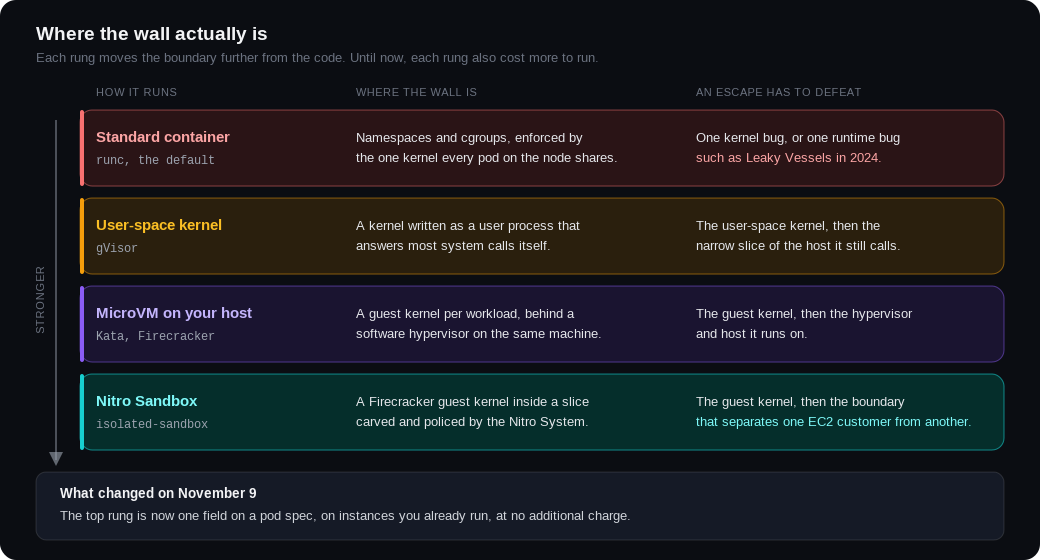
The industry has known this for years, which is why the ladder above exists. gVisor puts a user-space kernel between the workload and the host, so most system calls never reach the real kernel. Kata Containers and Firecracker give each workload a lightweight virtual machine with its own guest kernel, so an escape has to defeat a hypervisor instead. Each rung is stronger and costs more to run.
What AWS shipped is a new top rung, and it costs almost nothing to climb onto.
What Nitro Sandboxes change
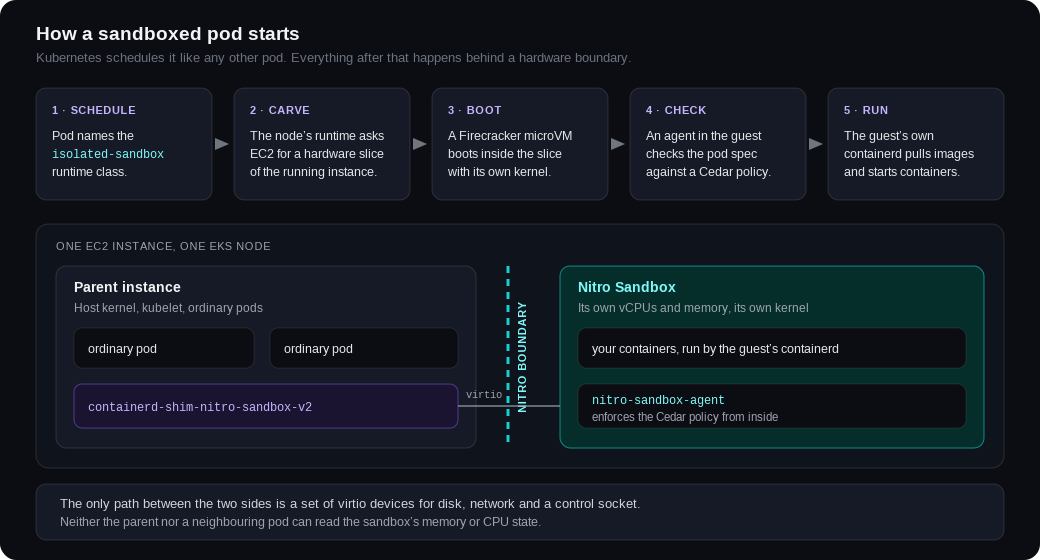
AWS Nitro Sandboxes let the Nitro Hypervisor carve a hardware-isolated slice of CPU and memory out of a running EC2 instance and boot a lightweight VM inside it. On Amazon EKS and Amazon ECS, each pod or task gets its own slice and its own guest kernel. The VM is a Firecracker microVM, the same VMM that has run AWS Lambda and Fargate since 2018.
On EKS, opting in is one field on the pod:
apiVersion: v1
kind: Pod
metadata:
  name: agent-run-7f3a
spec:
  runtimeClassName: isolated-sandbox
  containers:
  - name: runner
    image: <your-agent-runner-image>
isolated-sandbox is an ordinary Kubernetes RuntimeClass. On EKS Auto Mode it ships with every cluster alongside a second class, confidential-sandbox, and Auto Mode provisions sandbox-capable nodes on demand. Pod Identity, the VPC CNI, EBS, EFS and CloudWatch keep working. The announcement says there is no additional charge; you pay for the instances, as before.
Two details make this different from running Kata on your own nodes.
The first is where the boundary is enforced. With a microVM on an ordinary host, the hypervisor is software running on the same machine you are trying to protect. Here, the slice is carved and policed by the Nitro System, the same hardware and firmware that keeps one EC2 customer's instance from reading another's. AWS's EKS launch post puts it plainly: neither the host nor neighbouring pods can read the sandbox's memory or CPU state.
The second is the confidential mode. In confidential-sandbox, the parent instance itself is treated as untrusted. The Nitro Security Module measures the guest image and its policy into attestation registers, and an AWS KMS key policy can refuse to decrypt anything unless those measurements match. Encrypted image layers are carried by the host and decrypted only inside the guest. If that sounds like Nitro Enclaves, it is the same lineage. The Firecracker configuration for a sandbox literally contains an "enclave": {} block.
The part most coverage will skip
Read the EKS security model and one sentence reframes the whole feature: the sandbox is designed to run untrusted container images. It is not designed to run untrusted pod specs.
That distinction matters more for agents than for anything else. The pod spec is where you declare the image, the command, the environment variables, the volumes, the service account, and the network posture. AWS treats all of it as a trusted input. So if the component that decides how an agent's code runs can be talked into changing the spec, by a prompt, a tool call or a templating bug, the wall is now built around whatever the attacker asked for. RBAC and admission control on who may create pods with these runtime classes are not hygiene here. They are part of the boundary.
And then there is the bigger gap, the one the feature was never meant to close.
The sandbox protects the machine from the agent. It does not protect the world from the agent.
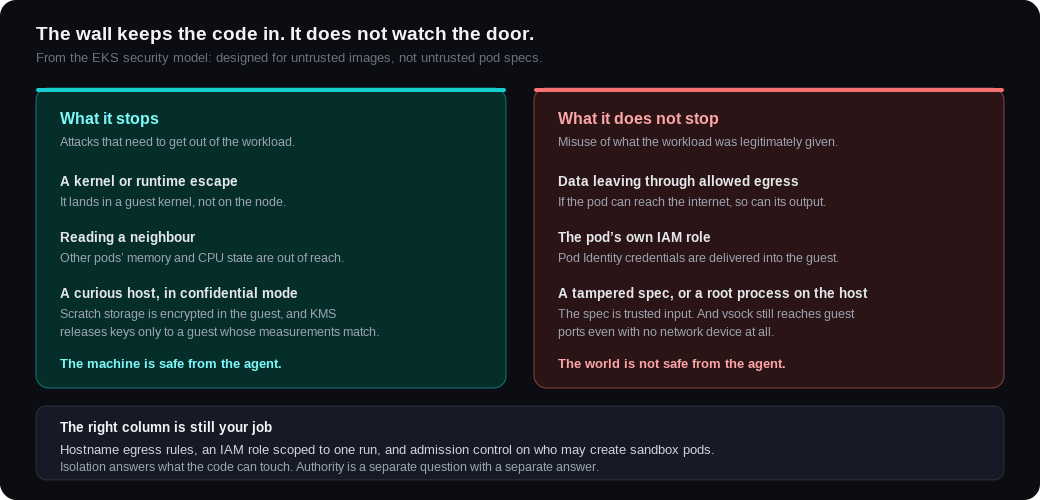
Think about what an agent's code actually does when it misbehaves. It rarely needs to escape anything. It reads the files it was handed, calls the APIs its credentials allow, and sends the result to a URL. Every one of those happens inside the sandbox, with the sandbox's blessing, because they are what the workload was given permission to do.
- Egress. A sandboxed pod keeps normal VPC networking unless you say otherwise. If it can reach the internet, it can post your data to the internet. Standard Kubernetes NetworkPolicy cannot match hostnames, which is why the EKS post pairs agent sandboxes with Auto Mode's
ApplicationNetworkPolicyfor hostname-based egress rules. - Credentials. Pod Identity credentials are delivered into the guest, so the agent holds exactly the IAM role you attached. A hardware wall around an over-privileged role is a very secure room with the vault key on the table. The security model also notes that the parent instance can mint credentials for any pod on the node, so treat the role as visible to the host as well.
- The quiet channel. The
sandbox.amazonaws.com/network-isolated: "true"annotation boots the VM with no network device at all: no DNS, no IMDS, no credentials. It is the right default for "run this snippet and give me stdout." But the docs are candid that a root process on the parent can still reach ports bound inside the guest over the Firecracker vsock socket, so they describe it as "not absolute isolation."
If you read the post on agent delegation, this is the same lesson from the infrastructure side. Isolation answers what can this code touch on the machine. It says nothing about what this code may do with the authority it was handed. That second question still lives in your IAM policies, your egress rules, and how narrowly you scope each run.
What it costs
The price is not money. It is a set of constraints that will surprise anyone who expects a sandboxed pod to behave exactly like an ordinary one. The EKS considerations page is worth reading in full; these are the ones that change a design.
Half your vCPUs, on x86. Core scheduling prevents two different sandboxes from sharing sibling hyperthreads of one physical core, so on SMT instances usable compute is "roughly half the advertised vCPUs." Graviton is not affected, because it has no SMT. If you are planning capacity for an agent fleet, that one line probably decides your instance family.
Fixed at boot. CPU and memory are allocated when the sandbox starts and cannot change. In-place pod resize does not work, and on EC2 the parent donates the full memory size up front and gets it back only when the sandbox terminates. Memory is not overcommitted.
Density has a ceiling. Total sandbox vCPUs on a node cannot exceed five times the node's vCPU count, and neither can the number of sandboxes. A 4-vCPU node tops out at twenty 1-vCPU sandboxes.
No GPUs. Firecracker does not pass host devices into the guest, so GPU and device passthrough are unsupported at launch. If your agent's code needs an accelerator, it does not run in this sandbox yet.
Throttled by default. Each pod gets 4,096 simultaneous outbound connections and 100 DNS queries per second unless you raise them with annotations. That is a sensible guard against one sandbox exhausting the node's conntrack table, and an unpleasant surprise for a scraper that resolves a new hostname per request.
No hostNetwork, a thin IMDS. Pods that ask for host networking fail to start. Inside the guest, the instance metadata service answers only placement and partition questions; IAM credentials come from Pod Identity or not at all.
One more thing to check before you plan around it: the announcement says Nitro Sandboxes are available in all commercial regions, while the EKS user guide currently lists the US commercial regions and requires Kubernetes 1.36 or later. Confirm the region you care about in the console rather than either page.
For latency-sensitive agent sessions, the EKS post points to the Kubernetes SIG project agent-sandbox, which can keep pre-booted VMs warm and hand one out in about two seconds. That number is for claiming a warm VM, not a cold boot, and AWS has not published a cold-start figure.
You have been running inside this for years
None of this is as new as it sounds. AWS Lambda and Fargate have run on Firecracker microVMs since 2018, so if you have invoked a function or launched a task in the last few years, your code has already lived inside this kind of wall. When AWS needed to run huge numbers of strangers' workloads on shared hardware, it did not trust a shared kernel to keep them apart. It gave each one a VM and made that VM cheap enough to boot in a fraction of a second.
What changed on November 9 is who gets to make that call. Until now, if you wanted VM-grade isolation per workload inside your own cluster, you assembled it yourself from Kata, a hypervisor and a lot of node tuning, or you pushed the workload out to a managed service and accepted its shape. Now it is a RuntimeClass, on the instances you already run, at no extra charge.
That is the architectural consequence worth noticing. The cost of the strong boundary just fell to roughly the cost of the weak one, which means "we used containers because VMs were too expensive" stops being a reason. It becomes a choice you have to defend.
What to do on Monday
If you run agent-generated code today, move it onto isolated-sandbox and default it to network-isolated unless the task genuinely needs the network. Most "run this and return stdout" calls do not.
When it does need the network, write the egress allowlist by hostname before you write the agent, and give each run an IAM role scoped to that one job. A short-lived role per session fails far more gently than a shared one.
Lock down the spec, not just the image. Restrict who and what can create pods with the sandbox runtime classes. Generate pod specs from a fixed template, and never let a model's output reach the fields that choose the image, the volumes or the service account.
Plan capacity on physical cores. Request CPU in multiples of two on x86, or use Graviton, and give memory requests a little headroom; the guide notes usable memory runs one to two percent under the request above 1 GiB.
Reach for confidential mode when the host itself is outside your trust boundary, such as a regulated workload or a tenant's model weights, and pin KMS key policies to the attestation measurements. The docs are blunt that attestation without a key-policy condition is "a measurement without enforcement."
Where the wall is now
For a decade, the honest answer to "is a container a security boundary?" was "sort of, if you are careful." Nitro Sandboxes make the careful version the cheap version: one line of YAML, and a pod's escape route runs through hardware instead of a shared kernel.
Just remember what kind of wall it is. It keeps the code in. It does nothing about the keys you handed the code on the way through the door.
Running agent-written code in production, or deciding whether to? I would like to hear where you have drawn the line. Find me on LinkedIn.
Discussion
Loading…