HTTP QUERY: The Method Was the Easy Part. The Cache Key Is the Problem.
Every engineer who has built a search API has had the same argument.
You need to send a filter object — nested facets, a date range, a geo polygon, forty selected checkboxes. It does not fit in a URL. So you reach for POST /search, and somebody on the review says but search isn't a mutation, and somebody else says I know, but GET can't have a body, and you ship the POST because the deadline is real and the semantics are not.
That argument is now twenty years old, and in June 2026 the IETF ended it. RFC 10008 defines QUERY: a method that is safe, idempotent, and carries a request body. It is the first genuinely new HTTP method since PATCH in 2010.
Most of the coverage has framed this as "GET with a body, finally." That framing is correct and it is not very interesting. The interesting part is what a safe, body-bearing method does to everything between your client and your origin.
What it actually is

Three properties, and until now you could have any two.
GET is safe and idempotent. Intermediaries know they can retry it, caches know they can store it, and a crawler knows it can follow it without consequence. What it cannot do is carry a body. Your filter object goes in the query string, where it collides with URL length limits that vary by proxy, and where it lands in every access log on the path.
POST carries a body of any size and shape. What it cannot do is tell anyone it was safe. To a cache, a proxy, a retry policy, or a browser deciding whether to re-send on refresh, POST means this may have changed something. Nothing downstream can treat it as a read, because the method does not permit that assumption.
QUERY is the first method with both. It carries a body, and it is declared safe and idempotent — so a client that loses a connection mid-flight can retry without asking whether it just charged someone's card twice.
Two details the diagrams tend to skip:
The RFC deliberately does not define a query language. The body's media type determines how the server interprets it — SQL, GraphQL, JSON, something you invented. That is a feature; HTTP has no business picking a query syntax. It also means Content-Type carries real weight. The spec is blunt: "Servers MUST fail the request if the Content-Type request field is missing or is inconsistent with the request content."
And because a client cannot know in advance whether a resource speaks QUERY, the RFC adds an Accept-Query response header. A resource advertises the query media types it accepts, as a Structured Fields list of media ranges. It applies to every URI on the server sharing that path — the query component is ignored — so one advertisement covers a whole family of URIs.
The part that is genuinely hard
Here is the thing that delayed this for two decades, and it was never the verb.
HTTP caching has keyed on the URI since 1996. Not mostly. Structurally. The method plus the target URI is the cache key, with Vary bolting on a handful of request headers as a secondary dimension. Every layer you own and several you do not — browser cache, CDN edge, reverse proxy, service worker — is built on the assumption that the request's meaning is fully expressed by the line at the top and the URL in it.
QUERY breaks that assumption. The request's meaning is in the body. Two QUERY requests to the identical URI can mean completely different things.
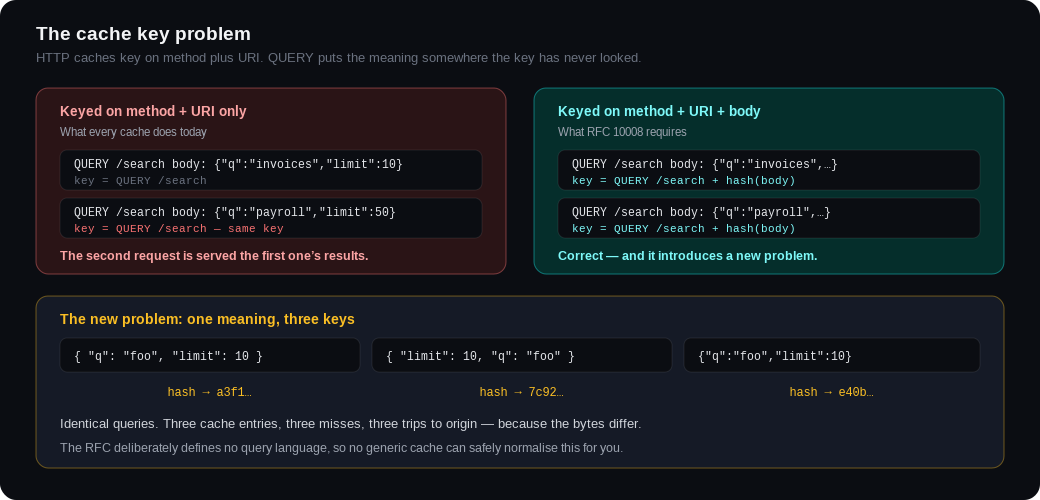
So the cache key has to include the body. Which sounds like a small change and is not, because now you inherit a problem that URL-keyed caching never had: semantically identical requests that differ byte-for-byte.
{ "q": "foo", "limit": 10 }
{ "limit": 10, "q": "foo" }
{"q":"foo","limit":10}
Three requests. One meaning. Three different cache entries, unless something in the path normalises them — and normalisation requires understanding the media type, which the RFC explicitly declined to standardise. A cache that does not speak your query language cannot safely canonicalise your query.
The practical consequence: your hit rate becomes a property of your client's JSON serialiser. For the opposite end of this trade-off — a cache that accepts being wrong in one direction in exchange for being tiny and instant — see the Bloom filter post. That is a strange and brittle place to put it. If you adopt QUERY for genuinely cacheable traffic, canonical serialisation stops being a style preference and becomes infrastructure — one ordering, one whitespace convention, enforced in a shared client, or your edge cache quietly degrades into a very expensive pass-through.
Two headers that sound identical and are not
RFC 10008 gives a server two ways to hand back a URI, and the distinction is easy to get backwards.
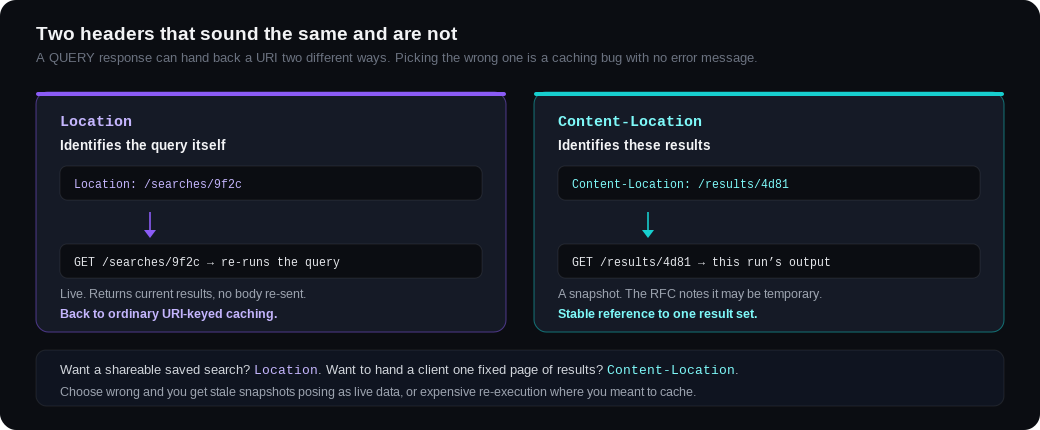
Location identifies the query itself as a resource. A subsequent GET to that URI re-runs the query and returns current results — without re-sending the body. This is the one that gets you back into ordinary URL-keyed caching: you pay the QUERY round trip once, and from then on you have a plain, cacheable, linkable, bookmarkable GET.
Content-Location identifies the results of this particular execution — a snapshot. A GET there returns what the query returned this time. The RFC notes this resource may be temporary.
The difference matters operationally. If you want a shareable saved search, you want Location. If you want to hand a client a stable reference to one specific result set — a report, a page of results a user is paging through — you want Content-Location. Choosing the wrong one gives you either stale snapshots pretending to be live, or repeated expensive re-execution where you meant to cache.
The Location pattern is also, quietly, the strongest argument for QUERY in production today: it converts an unbounded body into a durable URL, and from that point on your whole existing cache hierarchy works unmodified.
Why your traffic will not use it next quarter
A new method is not a new header. Headers degrade; unknown ones get ignored and passed along. Methods do not degrade — they get rejected.
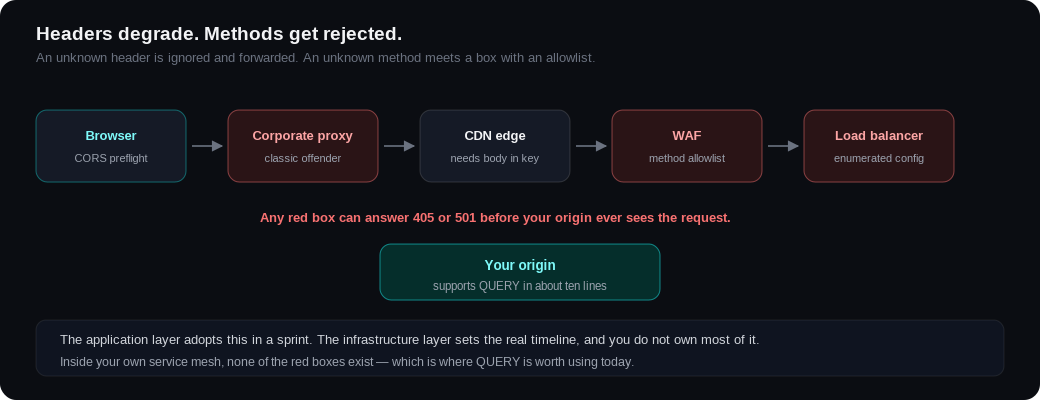
Count the hops between a browser and your origin. Each one is a piece of software that was written against a fixed list of methods, and a surprising number treat an unknown method as something to reject rather than forward. Corporate proxies are the classic offender. WAFs frequently have method allowlists. Older load balancer configurations enumerate methods explicitly. None of these fail gracefully; they fail with a 405 or a 501 from a box you may not control and possibly cannot see.
There is a browser-side cost too. QUERY is not a CORS-simple method, so cross-origin use triggers an OPTIONS preflight before every request unless you are returning Access-Control-Max-Age and getting preflight caching right. For a search box firing on keystroke, a preflight you did not plan for is a latency regression, not a rounding error.
None of this makes QUERY a bad idea. It makes it an idea whose adoption curve is set by the infrastructure layer rather than the application layer. Server frameworks will support it quickly — it is a small change to a router. Getting it reliably across the public internet, through other people's middleboxes, is a multi-year proposition. Plan for a fallback to POST and treat Accept-Query as the negotiation mechanism it was designed to be.
Where this actually earns its place
Four cases where QUERY is worth the trouble today, all of them inside infrastructure you control:
Service-to-service search and analytics. Inside your own mesh there are no corporate proxies. You get safe retries on a large query body immediately, which means your retry middleware stops having to special-case "this POST is actually a read."
Anything where the query currently leaks into logs. Filters in a query string end up in access logs, referrer headers, and browser history. Moving them into a body is a meaningful reduction in accidental exposure — the same reason nobody puts a token in a URL.
Queries that currently break on URL length. If you are already base64-encoding a filter object into a path segment to dodge a length limit, QUERY is strictly better than what you have.
GraphQL. It has spent a decade POSTing reads and losing every HTTP caching affordance as a result. QUERY plus the Location pattern is the most natural fix anyone has proposed.
Where it is not worth it yet: public, browser-facing APIs crossing networks you do not control. Use POST, and watch Accept-Query adoption.
The one thing to take away
HTTP did not lack a safe method with a body because nobody thought of it. The draft has existed in some form since the early 2000s. It took this long because the moment a request's meaning moves from the URI into the body, you have invalidated the organising assumption of every cache on the internet — and the specification had to say something coherent about that before it could ship.
RFC 10008's answer is honest rather than magical: the cache key must account for the body, and here are two headers that let you climb back out into URI-keyed caching as fast as possible.
Which is the real lesson, and it is not about HTTP. When you change what identifies a thing, you change everything that was indexing on the old identity. The verb was always the easy part.
Working through where QUERY fits — or does not — in something you are building? Find me on LinkedIn.
Discussion
Loading…